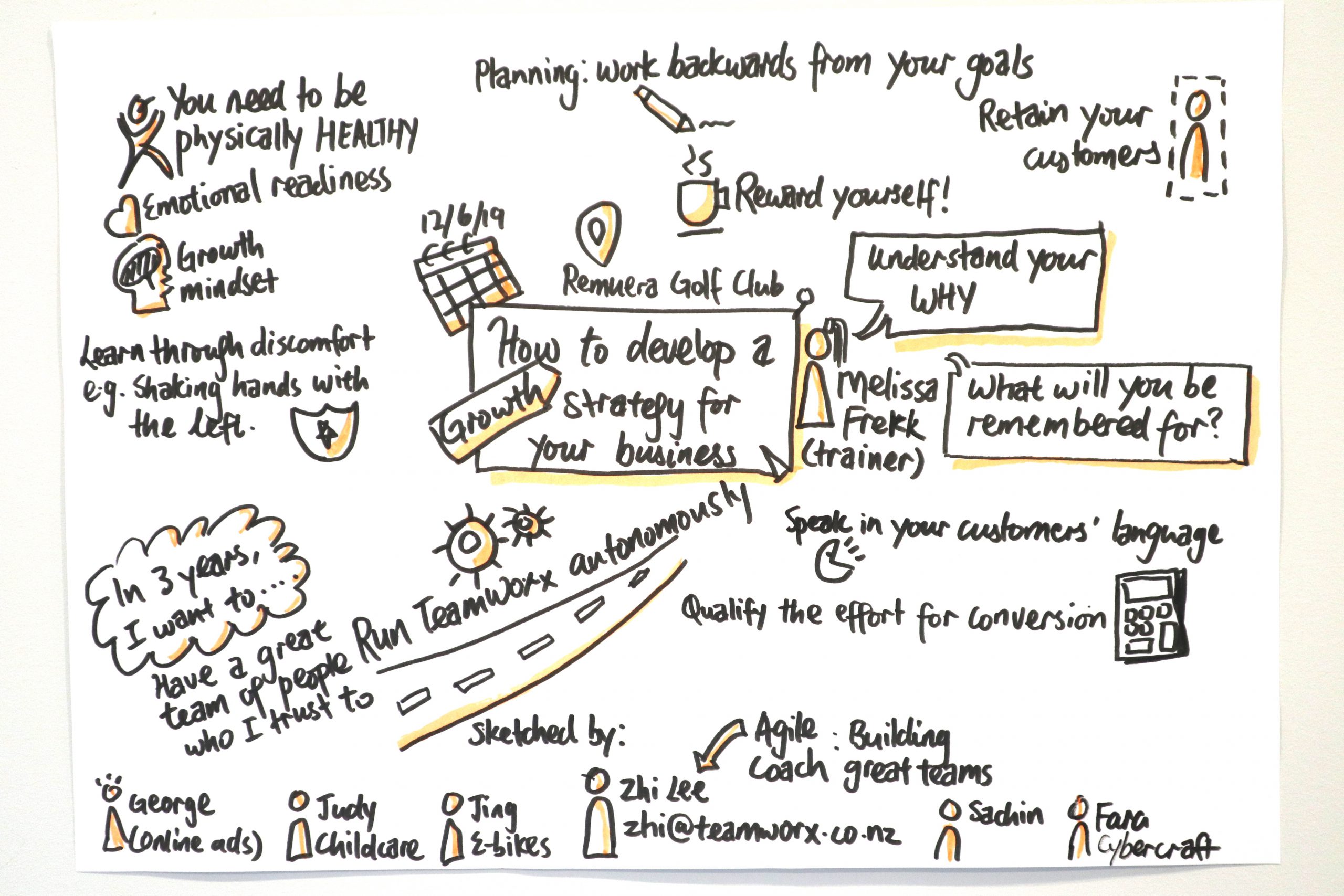
How to Develop a Growth Strategy for your Business – Melissa Frerk – Sketchnotes by Zhi Lee
- Teamworx
- 12 Jun, 2019
- 02 Mins read
- Blog and Activities , Tips and Techniques
I attended a workshop as part of the ANZ Business Startup Series. Thank you Melissa Frerk for sharing your insights and experience with us today. It was great to connect with like-minded business owners who want to do good things for their customers.
Workshop Overview
Melissa Frerk led a comprehensive workshop on developing a growth strategy for your business. Rather than just taking notes, we captured key ideas visually through sketchnotes—a technique for visual learning and retention.
Key Themes from the Workshop
1. Business Health First
Before focusing on growth, ensure your business fundamentals are solid:
- Financial health: Do you understand your numbers?
- Customer satisfaction: Are your current customers happy?
- Team capability: Do you have the right team?
- Clear positioning: Do people know what you offer?
Not all growth is good growth. Growth that strains your fundamentals leads to problems. Sustainable growth builds on a healthy foundation.
2. Strategic Planning
Growth doesn’t happen by accident. It requires intentional strategy:
- Vision: Where do you want to be in 3-5 years?
- Reality: Where are you now? What’s working? What’s not?
- Options: What are the strategic options available to you?
- Priorities: Which directions align with your vision and leverage your strengths?
The gap between vision and reality is your strategic challenge. Ask: “What do we need to do to close that gap?“
3. Know Your Customer
Too many strategies miss because they’re not grounded in customer understanding:
- Who are your ideal customers?
- What problems do they have?
- What language do they use to describe their needs?
- What alternatives are they considering?
- Why would they choose you?
Your growth strategy will fail if it’s not based on genuine customer understanding.
4. Clear Value Proposition
You need to be able to articulate clearly what value you provide:
- What problem do you solve?
- For whom?
- How is your solution different?
- Why should they care?
This clarity is what differentiates you in the market.
5. Revenue Model Alignment
Your growth strategy needs to be sustainable economically:
- How will you make money?
- What’s your unit economics?
- Does your pricing reflect your value?
- Does your business model scale?
Great products still fail if the business economics don’t work.
Practical Framework
Melissa shared a framework for thinking about growth:
- Define your ideal customer (not everyone is your customer)
- Understand their world deeply (research, interviews, observation)
- Identify the problem you solve uniquely (your differentiation)
- Develop your offering (product, service, or both)
- Test and validate (before scaling)
- Scale what works (leverage, systems, team)
Key Takeaways
- Sustainable growth builds on health: Fix your fundamentals before chasing growth
- Growth requires strategy: It’s not just getting bigger—it’s getting bigger in the right direction
- Customer understanding is critical: Know who you serve and what they value
- Clear positioning matters: You can’t grow if people don’t understand what you offer
- Test before scaling: Validate your assumptions before pouring resources into growth
For Business Owners
If you’re trying to grow your business:
- Start with health: Are your fundamentals solid?
- Get clear on strategy: What’s your growth vision?
- Know your customer: Do you truly understand them?
- Test your approach: Before scaling, validate it works
- Build scalable systems: As you grow, how will you maintain quality?
Growth is possible for businesses of all sizes, but it requires intentionality, customer understanding, and sound business fundamentals.
Thanks Melissa for the excellent workshop and for your generosity in sharing these insights with the startup community!
Stop "doing" process. Start delivering results.
Get in touch nowSee how we can help fine tune your business.