Print Your Own Planning Poker Cards (Fibonacci & T-Shirt Sizes)
- Teamworx
- 14 Aug, 2017
- 04 Mins read
- Agile Resources & Tools
Planning Poker is a group estimation technique, that allows you to quickly identifies gaps in understanding. It facilitates healthy discussion, and avoids team members influencing each other’s estimates.
How Planning Poker Works
- Present the Story: The Product Owner reads a user story
- Team Estimates in Secret: Each team member selects a card representing their estimate (without showing others)
- Reveal Simultaneously: When everyone’s ready, all cards are revealed at once
- Discuss Differences: If estimates vary widely, discuss why. Often one person has information others don’t
- Re-estimate: After discussion, estimate again
- Decide: When there’s rough consensus, write down the estimate
Why It Works
No Anchoring
Without simultaneous reveal, the first person to estimate influences everyone else. Simultaneous reveal prevents this anchoring bias.
Discussion is the Goal
The conversation about why estimates differ is more valuable than the final number. Often you uncover risks, unknowns, or different understandings.
Quick and Visual
It’s faster than round-robin discussion. Everyone estimates in parallel, then you have the conversation.
Psychological Safety
Hidden estimates feel safer. People aren’t worried about looking foolish for estimating high or low.
Fibonacci Scale
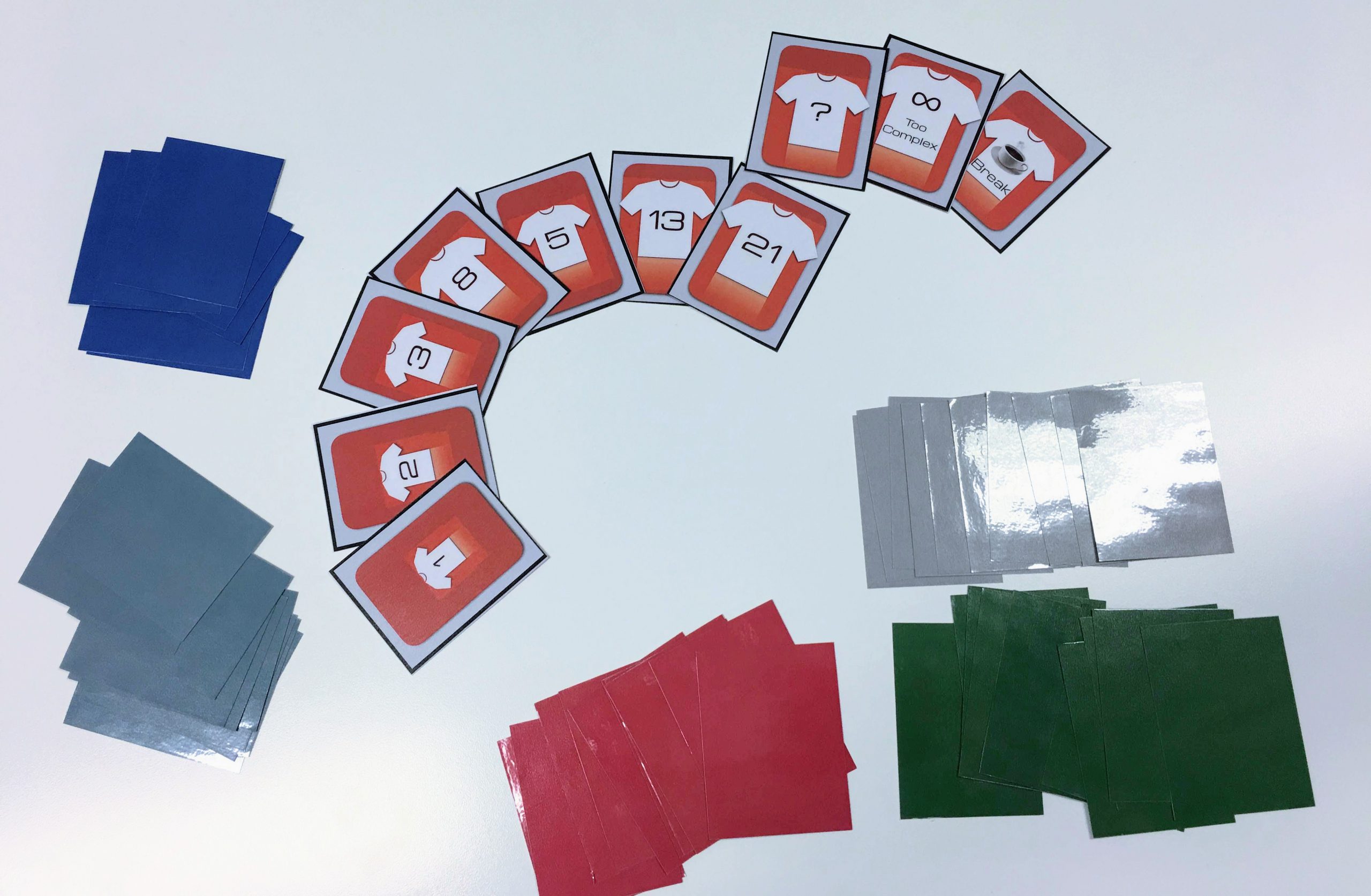
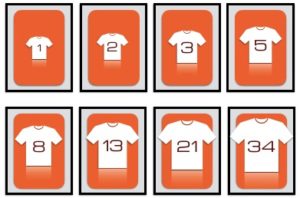
Most teams use the Fibonacci sequence: 1, 2, 3, 5, 8, 13, 21, 34, ?
Why Fibonacci? Because:
- Small differences are meaningful (1 vs. 2)
- Large differences are harder to distinguish (13 vs. 21 is more meaningful than exact differences)
- The increasing gaps reflect reality: bigger items are harder to estimate accurately
T-Shirt Sizes
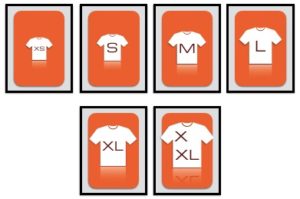
Some teams prefer semantic sizing: XS, S, M, L, XL, XXL
This works just as well. The scale is the same—relative sizing. Pick the language your team prefers.
Card Contents
Our Planning Poker cards come in two versions:
Fibonacci Version
Numbers: 0, 1, 2, 3, 5, 8, 13, 21, 34, ?, Question Mark
0: Nothing to do (or already done) ?: We need more information—we can’t estimate this
T-Shirt Version
Sizes: XS, S, M, L, XL, XXL, ?, Question Mark
Same principle, different language.
How to Print the Cards
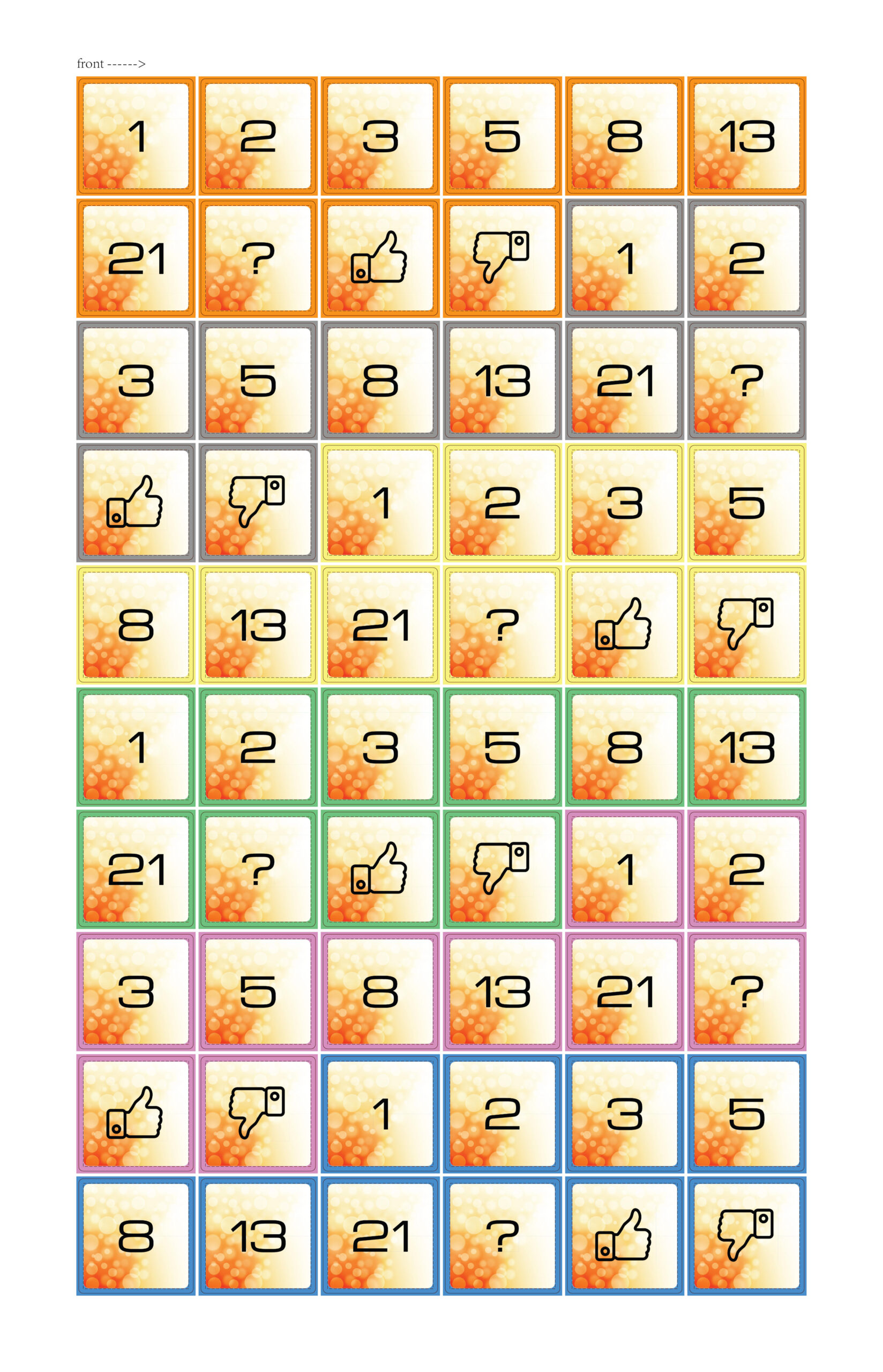
- Download the template (PDF)
- Print two sets per card (front and back)
- Cut along the lines
- Optional: Laminate for durability
- Optional: Hole-punch and put on a ring
Each person should have a full set of cards.
Tips for Better Planning Poker
1. Clear Story Reading
The Product Owner reads the story clearly, ensuring everyone understands what’s being estimated.
2. Q&A Before Estimation
Allow clarifying questions before estimating. A story that’s unclear will have wildly different estimates.
3. No Hidden Calculation
The point isn’t to estimate time. It’s to estimate relative complexity.
4. Discuss Outliers
If someone estimated 2 and another estimated 13, that’s valuable information. Discuss.
5. You’re Not Always Right
If you estimated 8 and 7 others estimated 5, you might be overthinking it.
6. Re-Estimate if Major Understanding Shifts
If discussion reveals something new about the story, it’s OK to re-estimate.
7. Avoid Perfectionism
You don’t need perfect estimates. “Good enough” is good enough. Move on.
Common Estimation Mistakes
- Confusing points with hours: A 5-point story doesn’t equal 5 hours. It’s relative complexity
- Over-discussing: “Are you sure it’s 8 and not 7?” Spend 30 seconds on the conversation, not 10 minutes
- Averaging estimates: If people estimate 3, 5, 8, take the middle-ish number (5). Don’t average to 5.3
- Estimating what’s already being done: If a story is mid-sprint, don’t re-estimate. Continue with the original estimate
Velocity Tracking
As you estimate stories, track how many points you complete each sprint. That’s your velocity.
Over several sprints, your velocity stabilizes. If you complete 24 points per sprint on average:
- A backlog with 90 points ≈ 4 sprints
- 144 points ≈ 6 sprints
This is how story points enable forecasting without perfect estimation.
Download the Cards
We’ve created free printable Planning Poker cards in both Fibonacci and T-Shirt sizes. Download, print, cut, and start estimating.
Download Planning Poker Card Template (PDF)
No card sets yet? Start with the free printables. Once your team gets comfortable with Planning Poker, consider investing in published card sets for durability.
Try It
If you’re not using Planning Poker, give it a try. The benefits:
- Faster estimation
- Better discussion
- More accurate relative estimates
- More psychological safety for the team
Download, print, cut, and start playing. Your retrospectives will thank you.
Want the Real Thing?
Skip the scissors
Physical Planning Poker Cards — $34.95
Six colour-coded sets so every team member has their own durable deck. Fibonacci values, free NZ shipping, and ready to play straight out of the box.
Shop now — $34.95 →Stop "doing" process. Start delivering results.
Get in touch nowSee how we can help fine tune your business.