What is Agile? A Complete Guide to Agile Methodology
- Zhi Lee
- 21 May, 2024
- 04 Mins read
- Agile Resources & Tools
Agile is a mindset about responding to change. It is described by the twelve principles outlined in the Agile Manifesto, a declaration of values and principles for software development that has become the foundation for modern approaches to project management across all industries.
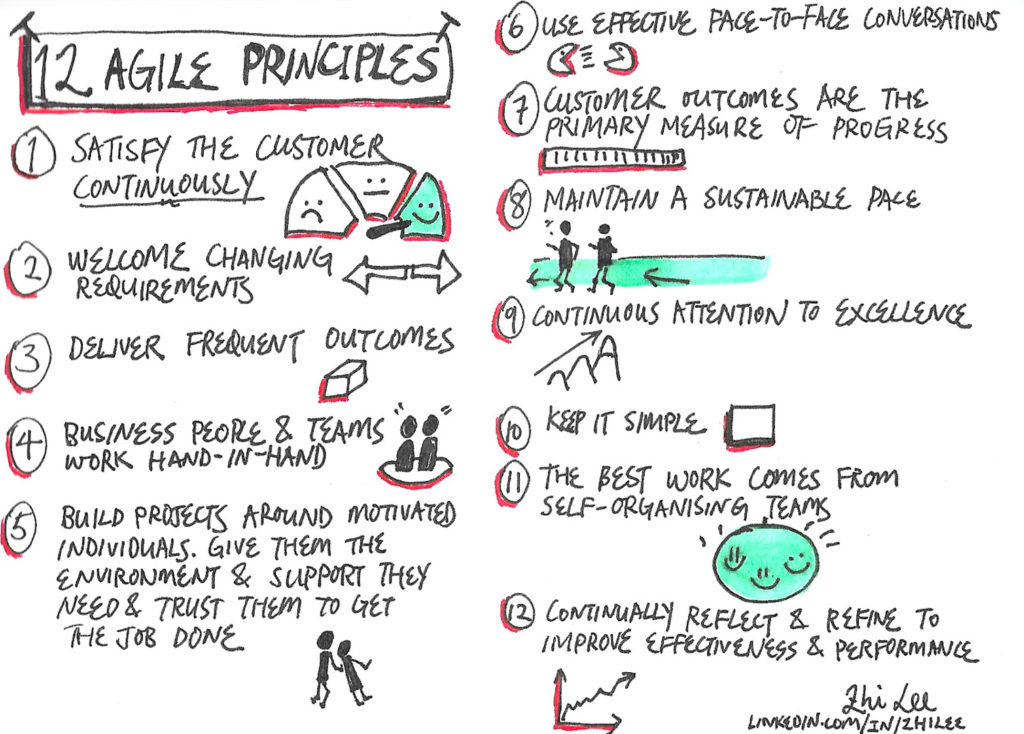
The 12 Agile Principles at a Glance
What is Agile?
Agile is a set of values and principles that guide how teams approach complex projects. Rather than planning everything upfront and executing according to a rigid plan, Agile teams work in short cycles (called “sprints”), regularly check in with stakeholders, and adapt their approach based on feedback and changing requirements.
The Four Core Values of Agile
The Agile Manifesto identifies four core values:
1. Individuals and Interactions over Processes and Tools
While processes and tools are important, the focus should be on people collaborating effectively. Great teams with basic tools will outperform poor teams with sophisticated tools.
2. Working Software (or Product) over Comprehensive Documentation
The goal is to deliver real, working results that provide value. Extensive documentation is secondary to having something that works.
3. Customer Collaboration over Contract Negotiation
Rather than detailed contracts that lock in requirements, Agile emphasizes working closely with customers throughout the project to understand and meet their needs.
4. Responding to Change over Following a Plan
While planning is important, Agile recognizes that requirements change, and teams should be flexible enough to adapt rather than rigidly following a predetermined plan.
The Twelve Principles of Agile
Beyond the four values, the Agile Manifesto includes twelve principles:
- Satisfy the customer through early and continuous delivery of value
- Welcome changing requirements, even late in development
- Deliver working solutions frequently (weeks rather than months)
- Business and development collaborate daily
- Build projects around motivated individuals who trust each other
- Face-to-face conversation is the most efficient way to communicate
- Working software is the primary measure of progress
- Maintain a sustainable pace of development
- Technical excellence and good design enhance agility
- Simplicity — do only what’s essential
- Teams self-organize around their work
- Regularly reflect and adjust to become more effective
Key Agile Frameworks
Agile is an umbrella term for several frameworks and methodologies:
Scrum
The most widely used Agile framework. Teams work in sprints (typically 2-4 weeks), with defined roles (Product Owner, Scrum Master, Development Team) and ceremonies (Sprint Planning, Daily Standup, Sprint Review, Retrospective).
Kanban
A visual system for managing work and the flow of value. Work items move across a board (To Do → In Progress → Done), with a focus on continuous delivery rather than timeboxed iterations.
Lean
Emphasizes eliminating waste and delivering value with minimal resources. Often combined with other Agile frameworks.
XP (Extreme Programming)
Focuses on technical excellence through practices like pair programming, continuous integration, and test-driven development.
The Agile Mindset
Beyond frameworks and practices, Agile is fundamentally about mindset. An Agile mindset includes:
- Embracing change rather than fearing it
- Learning continuously from experience
- Collaborating openly with team members and stakeholders
- Delivering value incrementally rather than all at once
- Focusing on outcomes, not outputs
- Taking ownership of work and results
Benefits of Agile
Organizations that adopt Agile often experience:
- Faster time to value — delivering working solutions in weeks rather than months or years
- Better quality — continuous testing and feedback catch issues early
- Improved team morale — empowerment and autonomy lead to more engaged teams
- Reduced risk — regular feedback and adjustments catch problems before they become expensive
- Higher customer satisfaction — customers see progress regularly and their feedback shapes the product
- Better adaptability — teams can pivot quickly when requirements change
Is Agile Right for You?
While Agile has many benefits, it’s not a one-size-fits-all solution. Agile works best for:
- Projects with evolving requirements — where you can’t know everything upfront
- Complex problems — where you need to learn and adapt as you go
- Cross-functional teams — that can collaborate closely
- Organizations willing to embrace change — both in process and in how they work
Agile may be less suitable for:
- Projects with fixed, well-defined requirements
- Highly regulated environments (though Agile can still work here with adjustments)
- Teams that work in silos
- Organizations resistant to changing traditional processes
Getting Started with Agile
If you’re interested in exploring Agile for your organization, here are some first steps:
- Understand the principles — Read the Agile Manifesto and understand what resonates with your team
- Start small — Pilot Agile with one team or project before rolling it out organization-wide
- Get training — Consider Scrum Master or Agile coaching to help your team succeed
- Be patient — Cultural change takes time; expect a learning curve
- Inspect and adapt — Use Agile principles on your Agile adoption; regularly reflect and improve your process
Conclusion
Agile is more than just a set of practices — it’s a philosophy for working that puts people first, values learning and adaptation, and focuses on delivering real value. Whether you’re in software development, product management, marketing, or any other field, Agile principles can help your team work more effectively and respond to change with confidence.
The journey to Agile is just that — a journey. It requires commitment from leadership, openness from teams, and willingness to challenge the status quo. But for organizations that embrace it, the rewards — in terms of speed, quality, and team satisfaction — can be substantial.
Ready to explore Agile for your organization? At Teamworx, we help teams and organizations adopt Agile practices through coaching, training, and facilitation. Learn more about our services.
Stop "doing" process. Start delivering results.
Get in touch nowSee how we can help fine tune your business.